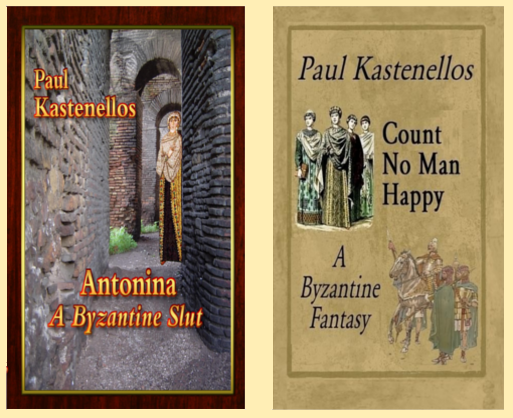
Apuleius Books is pleased to announce the publication of a new novel by Paul Kastenellos – Antonina, A Byzantine Slut.

In the year 531 AD the late Roman (Byzantine) general Flavius Belisarius married a prostitute named Antonina. Though little known in the west, Belisarius was perhaps the noblest person ever to lead great armies and is considered to be one of the ten – some would argue three – most successful commanders in history.

Belisarius loved and was faithful to Antonina their whole lives together. Antonina loved him yet engaged in a ten year affair with their godson. They accompanied Belisarius on his military campaigns in which he regained North Africa and Italy for the Emperor Justinian who now resided in Constantinople. She also became the chief confidant of the Empress Theodora and acted as her agent in the reconquered lands. In an age when wives might be secluded and without political power, Antonina raised and led an army in Italy and stood a year-long siege in Rome.

Regrettably, the historical picture of Antonina has been colored by the hatred for her of Belisarius’ adoring but prissy biographer. In this book we see the life of her famous husband through Antonina’s realistic eyes, and Antonina, through his. Theirs is a love story worth telling.

Antonina “descended from a family of charioteers; and her chastity has been stained with the foulest reproach. Yet she reigned with long and absolute power over the mind of her illustrious husband; and if Antonina disdained the merit of conjugal fidelity, she expressed a manly friendship to Belisarius, whom she accompanied with undaunted resolution in all the hardships and dangers of a military life.”

Edward Gibbon … The Decline and Fall of the Roman Empire

“All this can be properly attributed to folly, for it is she who sees that a wife is attractive to her husband and a husband to his wife, that peace reigns in the home and their relationship continues. A husband is laughed at, cuckolded, called a worm and who knows what else when he kisses away the tears of his unfaithful wife, but how much happier it is for him to be thus deceived than to wear himself out with unremitting jealousy, strike a tragic attitude, and ruin everything!”

Erasmus of Rotterdam … In Praise of Folly

Apuleius Books is pleased to announce the kindle marketplace version of Antonina: A Byzantine Slut appearing without DRM for the reader’s convenience.

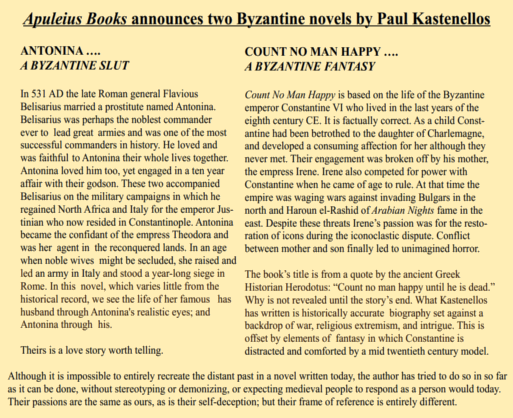
Count No Man Happy is based on the life of the Byzantine emperor Constantine VI who lived in the last years of the eighth century CE. It is factually correct. As a child Constantine had been betrothed to Rotrud, the daughter of Charlemagne, and developed a consuming affection for her although they never met. Their engagement was broken off by his mother, the empress Irene. Irene also competed for power with Constantine when he came of age to rule. At that time the empire was waging wars against invading Bulgars in the north and Haroun el-Rashid of Arabian Nights fame in the east. Despite these threats Irene’s passion was for the restoration of icons during the iconoclastic dispute. Conflict between mother and son finally led to unimagined horror.

Although it is impossible to entirely recreate a past world in a novel written today, the author has tried to do so in so far as it can be done, without stereotyping or demonizing, or expecting medieval people to respond as a person would today. Their passions are the same as ours, as is their self-deception; but their frame of reference is entirely different.

The book’s title is from a quote by the ancient Greek Historian Herodotus: “Count no man happy until he is dead.” Why is not revealed until the story’s end. What Kastenellos has written is historically accurate biography set against a backdrop of war, religious extremism, and intrigue. This is offset by elements of fantasy in which Constantine is distracted and comforted by a mid twentieth century model.

Apuleius Books is pleased to announce the kindle marketplace version of Count No Man Happy… A Byzantine Fantasy appearing without

12
Dec

Directory of Essays

Posted by: belisarius   in Essays from the Publisher

Use these links for easy access to individual Essays.

Essay on Nazis

Essay on Japan and Western Relations

Essay on Slavery

Essay on Obedience
 
Essay on Ethical Monotheism Written for a Grandchild
 

FROM THE PRELUDE


It had been fifteen hundred and thirty three years from the founding of the city of Rome, and seven hundred and eighty years from the birth of Jesus of Nazareth. It was now four hundred and fifty years since Constantine the Great had founded a New Rome at Byzantium where Europe meets Asia on the Bosphorus.

With the melting of the last snowfall, infantry from that New Rome, more commonly called Constantinople, were retreating from a small fort on the Dacian frontier, pursued by Bulgar warriors.

It wasn’t much of a fort; just a stockaded trading post fifty miles beyond the frontier proper and not very different from a forward post on the U.S. or Canadian frontier in the nineteenth century. It was just a place to trade with the locals or seek refuge if the natives turned enemy.

At first the Byzantines held formation but not for long. The peasants who lived outside the palisade just ran — those able to.

In the past Bulgar raiders would have been content just to kill a few troopers, fire the buildings, grab what loot they could carry, and return east to where a relief army would not follow.

This time they hunted down and butchered both the soldiers and the refugees.

But in the new Rome a beautiful empress reigned in the name of her young son while in Western Europe Charles the Great – Charlemagne – was entangled with warring German tribesmen, A Bulgar incursion hardly stirred the court life of either state. Charles was stretching the boundaries of Christianity and his kingdom, while the courtiers in Constantinople were more concerned with trade, fashion, and forms of worship, than with a minor raid outside the frontier proper.


Here we continue publishing of excerpts from Paul Kastenellos new book, Count No Man Happy… with one from chapter one.

FROM CHAPTER 1


Beth Pagane climbed the three flights to her one bedroom apartment over a bakery on Broad street in Newark, New Jersey. Balancing a bag of groceries on her hip as a mother might a small child, she unlocked the door and entered. Beth was not a mother, not even married yet, and the clock was ticking. The year was 1956. Women were “girls” until “matronly,” or were “ladies,” depending upon the circumstances. Men were “boys” until married and “unavailable.” Eisenhower was president and The Great Pretender by The Platters was the hit song of the month. Beth liked The Platters; everyone did.

Beth put the groceries away and began to undress, slipping out of a pair of well-worn flats, a simple white blouse, and the tan pedal-pushers that accented her rump. Except for that concession to the boys Beth preferred to dress comfortably when not working. But in the mirror wearing only her undies she scrutinized another Beth, the pinup model — the fantasy gal — Beth with the big butt who had to constantly watch her otherwise slim figure or be out of work. She knew she was pretty, but no more so than a lot of other girls. True, God had blessed her with a beautiful body, winning smile, and light blonde braids that fell to her waist when she let them; but still, with her hair up and without makeup she might pass most men unnoticed. That was good. Not that she didn’t like men; oh, she surely did, but she didn’t like being stared at when she wasn’t working.

On her bedside table were two crystal bells – Christmas ornaments she’d bought on a lark some weeks before. She held them, listened, and watched them take the light before placing them in the far back of a drawer behind an Arabian harem pajama and a pair of frilly panties. The panties she’s purchased more for their frill than their coverage which was minimal, but she wasn’t sure if any of these things really belonged in her trousseau. That would depend on what sort of guy she would marry one day, and at the moment that day seemed to be very far off.

Evening was approaching and she had nothing scheduled for the night. That too was good. Too much partying had become boring. She had to dress for parties and if she did guys drooled all over her, which did little for her popularity with the other girls and wasn’t fun for her either. She would have loved a guy who’d ignore her a bit –- just a bit –- not too much, mind you. Tonight she’d just put on her old jammies and relax. Perhaps read a bit, she thought. Read some history. Beth had always liked history. If she’d not taken up modeling she’d intended to get a degree in it; probably teach, do some research, maybe specialize in the eighth century when according to historians Charlemagne was inventing Europe.

Tonight there was nothing on her schedule so after a quick TV Dinner without the TV Beth grabbed her old blanket and settled herself on the couch to read. If she was hoping for exciting reading Beth was to be disappointed. The first pages were anything but promising.


FROM CHAPTER 8


Beth was without fear or worry. She had a mission to be sure, but no care. She was entirely young and pretty in both the eyes of God and his children. Her image began to float earthward. On his bed Constantine sensed her. As the priests taught, he forced his mind to matters not of the flesh

“In the morning when thou art sluggish at rousing, let this thought be present: I am rising to a man’s work.” Constantine tried but it was not easy to emulate Marcus Aurelius. Come to think of it, Marcus must have had the same problem getting up, otherwise he’d not have had to encourage himself. “Flinch not, neither give up nor despair if the achievement of every act in accordance with right principle is not always continuous with thee.” Constantine rolled out of bed with a small smile on his lips. Maybe the old emperor wasn’t such a perfect model after all … Stodgy though.

He was growing up and he knew it. Last year he had been betrothed to the daughter of Charles of the Franks and this year his military training had begun in earnest. For two hours each day he trained with sword and ax and bow. For another hour he studied strategy and tactics at the palace command school. This was the first time in his life that he had shared a classroom with other boys rather than studying alone with a tutor; but these things were not arts to be studied alone. He had to match and hone his own skill and insights against other boys in argument and tabletop war games. Then too, when he would come to command armies he would need subordinate commanders whose judgment and abilities he understood as well as he did his own. Commanders in the Byzantine army came from many places, including the ranks, but it was those he knew now who he would most trust in battle because he knew what they would do. As a later commander would say: “The battle of Waterloo was won on the playing fields of Eton.”

Yet Constantine was not so old that he did not enjoy lying abed with a pet cat and that was what he would do this fine morning. Old Furface was not just any palace cat. A social climber, she had somehow become the emperor’s own pet many years before when they had both been very young. Not that Constantine wouldn’t stoop his serene self to chuck a rival under the chin; but there was a special place in his heart for this animal which shared the imperial bed and could be counted on to wake beside him each morning with an annoyed look, wondering no doubt why her friend had to always rise so early.

They both had breakfast and, although it was not the usual thing, Constantine then returned to his chambers with Furface, or rather he followed the cat back to the bed. The sun was bright and warm through the marble lattice and while they’d been eating breakfast the pale green and white marble room had been cleaned and decorated with small sculptures and brightly colored flowers. Just as it should be, the cat was probably thinking if it was thinking anything at all. Her eyes were slowly closing and the emperor lay quietly so as not to disturb her. Though Constantine was still young, Furface was not as the lives of felines go. At best she was middle aged going on elderly and the emperor dreaded the day which must come when she would die. Of course being emperor, he already had enemies. It was possible that she would outlive him. He was unsure which thought depressed him more.

Am I brave or a coward?, the young emperor questioned himself. He did not know and Furface, if she knew, was not answering either. When will death come? When I am young or old, or sometime in between? The question was pointless as Marcus would have noted. It would come at God’s chosen moment and that was that. But how he would meet it worried the boy. A shepherd or farmer, even a soldier, might die crying and soon no one would remember either him or his death; not so one born to the purple. He must die well as he must live well. It must have troubled old Marcus Aurelius despite all his protestations. After all, their memory among men was all the pagan emperors had to trust in. For a certainty, he too had known fear and been uncertain of his own bravery. “Do not worry about it,” the patriarch had assured Constantine: “You will die well if you have lived well.”

Is that so? Constantine hoped so, for he was trying his best to live well. The priests had given him the martyrs to emulate and John Pikridios had given him old Marcus. What was it Homer sang? “It is not unseemly for a man to die fighting in defense of his country.” He could try to die well if he died in some battle against some enemy of his people – he owed them that. But how would he face some assassin in the night without his friends and comrades about him to steady his resolve? What if he were wounded and his dying took days or weeks? How can a man die well like that? I am not an ancient hero. I will try, but I am not a hero. What if I am tortured?


We continue publishing excepts from Paul Kastenellos new book, Count No Man Happy…

FROM CHAPTER 11


The fall from his horse had not seemed bad. Constantine had been stunned for only a moment, or so he thought. His companions had quickly gathered around him. Even Stauratius and Aetius had laid aside their hot rivalry and cold courtesy to tend the boy together. Nasoforis himself brought cool water from the stream the party had been about to cross. He wiped off a trickle of blood and made a compress to cool the emperor’s head. At everyone’s urging Constantine agreed to rest awhile under a large elm while the others gathered in concerned groups talking together.

Alone under the elm Constantine allowed his mind to wander, or rather urged it to wander away from the groups of old people talking together and into another view. The scenery was the same: the stream, the trees, the undergrowth; but he chose to imagine that he was in Rotrud’s homeland with all their courtiers and guards gone.

“Hi!”

Had he been standing Constantine would have spun on his heel. But he was lying under the elm and could only look up into the sky as a grin bore down on him.

“Rotrud?” the boy stammered.

It was Rotrud – but not at all as Constantine had expected her. True she was blonde and pretty and had long braids and her face was that of the image he carried against his heart, but this girl who flashed a smile like the sun seemed no retiring daughter of the Frankish court, happiest surrounded by books and pets. This Rotrud was out of the northern legends themselves, or from his dreams. She bent over him and let her braids touch his face. Her skirt, which did not come even near to her knees, was all of black leather. It snugly hugged a large round rump. Her bodice was mostly black leather straps, and it too was filled to overflow. Rotrud had been but twelve when first they had been engaged, but obviously in the several years since, the child had changed. In her hand she held a whip. Vaguely Constantine recalled some images, all black and shades of gray.

“Do you like your wife, my lord Emperor of the Romans?” Rotrud spoke in a bright, cheerful laugh of a voice. Her bright wide eyes lit the smile she smiled on her husband-to-be. Nor did Constantine take any offense at her playfully mocking tone – How could he, beneath that sunshine grin?

Constantine said nothing; he had never seen anything like the girl who stood before him gently swinging a whip. Even in the theater women dressed more modestly even if actresses did not often behave so.

“Hey, it is the fault of the great autocrator himself, Your Sovereignty, if I’m not like the picture you’ve carried for so long. It was you who wanted to see me here in my woods. I’d have been more than happy to go to your city, Illustrious Sir. In fact I was looking forward to it. Then I’d have dressed like a proper princess for your stuffy friends. Would you rather that? I can leave you….”

“No. Absolutely no.” Constantine jumped to his feet. He was so stimulated to actually see the fiancé whom he’d only dreamed of until now that his superheated mind and glands raced with each other, neither winning his undivided attention. He was so overwhelmed by that smile that his bowels became queasy in his belly. He actually liked the disrespectful tone this Frankish bride took with his august self.

“Dare you to catch me!” Rotrud took off like a deer and Constantine chased after her bouncing leather-clad bottom. She spun round in a clearing and grabbed her future mate as he almost plowed into her. Briefly she looked into his eyes. Then she slipped to the ground under him and pulled him down onto herself. She felt so nice that they play-wrestled for many minutes till finally Rotrud ceased squirming and Constantine lay quiet on his stomach next to her, not thinking of anything but what fun married life would be. Then, unexpectedly. she jumped onto his back and bounced again and again while he feigned pain and fear. But it was all play-acting like his cheetahs’ cubs playing at fighting. After a few long seconds she stopped bouncing and lay her golden head next to his. The fifteen year old emperor heard Rotrud whisper in his ear. “You are sweet, milord; not at all like an emperor should be.” Then she was gone.

When Constantine awoke he was being carried on a litter by four of his guardsmen back to the city where court physicians would worry over him hourly for a week before they agreed that the mild concussion had done the emperor no lasting harm. Strangely, the empress-regent continued her usual routine at court showing little more than formal concern for her son. He hardly cared.


FROM CHAPTER 17


“Beth, with those long legs you should have been a dancer.” Eddy Miller was posing his favorite model.

“Oh, I did take a few lessons in school, but I didn’t like the teacher. ‘First position … second position … en pointe.’ Not a lot of fun.”

“Do you think you could still pose those positions?”

“Not on my toes. I never really got on pointe before I quit; and I haven’t the ankle muscles.”

“It would make a nice spread. You could wear something long with those stems peeking out when you spin.”

“It wouldn’t be much of a pinup. I can’t see guys who look at Titter being turned on by ballet.”

“I’d like to see you dance, Beth.”

They looked at each other for a long moment. Beth was smiling her famous smile, but Eddy seemed lost in thought. It was time for Beth to leave. When she had gone Eddy walked into the night in search of relief.

____________________


It was evening in Constantinople. Constantine with a few disguised guards had slipped away from the palace. The teenager wanted to see the city, the real city which had not been prepared for a visit by the Anointed of God: swept, decorated and perfumed, and strewn with flowers….

It was evening but not yet night. There was still light on the streets lined with stucco and terra cotta houses. Some of the houses also served as shops or workspace for their tenants but others were just dwellings. Those who did not work in their houses but on small farms, or were merchants, or were employed in the city’s many workshops were headed to their homes. Many looked tired from the hard work of their day but others were walking together in pairs or small groups, sometimes talking quietly and seriously but sometimes laughing too. God told Adam: “By your sweat you shall earn your bread” and so they do. It was not an unhappy populace just a weary one. Soon they would be with their wives and children. There would be food enough. Even those who could not afford much meat would still have plenty of bread and vegetables. Bread was free for the poorest and anyone could grow a few vegetables in the fine Constantinoplian climate. Good water was brought from the mountains by the city’s aqueducts and was free at the fountains. Simple table-wine was inexpensive.

Constantine stumbled on a paving stone that stood up too high. He recovered just as one of the guards rushed to support his emperor. Together they entered a small square where an unimpressive fountain took the last gleams of twilight. It was not one of the great forums but a simple crossing of streets with a fountain. Some merchant who might have been busy a few moments before with a last minute sale was still closing his stall and rolling his awning. An hour ago the little square would have been very busy and noisy. Now it was quiet and pretty in a simple way that Constantine noticed more than those who spent their days there would have. It was nice to just look around at the things that generations of plain folk had produced. Simple things like paint on wooden window sills instead of the marble-work that was polished daily at the palace. He noted the roofs of red clay and the tastefulness of arches and vaults about him. There were no trees, only stone and stucco and a few plants in pots for their color. This was the city. It felt almost enclosed, and every sound was loud. Some reverberated. There was enough of nature not far away, olive groves and orchards even within the walls. People here were happy to be clustered one family upon another where they could chat together without even leaving their windows. Besides, the summer had been unusually cool so the stench was tolerable and nothing more than Constantine was used to. At night the mule shit would be collected for monastery farms. Gutters beside the traveled way removed much of the other wastes when it rained. His people lived in this scene and were so accustomed to it and so busy with their routine chores that they hardly noticed it was pretty — except maybe sometimes, when the seasons changed and the breeze was fresh, and there was nothing of importance for one of them to deal with. Then he might take a moment to rest by the fountain and sip a little water before heading home to dinner, children, and finally bed with the wife he loved.

The last rays of the sun gilded the simplest things. Constantine was totally relaxed and without a care. Far down a street with a view of the sea behind her, a dancer pranced from one doorway to another. Her steps and clothing were not of his century. Back-lit by the sunset her whole long legs flashed beneath a full-length skirt. For just a brief moment she stood en pointe. Constantine was amazed. It was the most beautiful pose he had ever seen, in its way more erotic than when Beth wore boots and a thong.


FROM CHAPTER 23


With the next dawn Constantine joined his troops. The memory of Beth was nothing but the remnants of a very pleasant dream which he shook off with the light. Of the map he remembered nothing at all.

Services were held before dawn in the Great Cathedral. As he afterwards rode through the crowds that lined his path to the triple walls he thought of how beautiful the earth can seem when death may be near. “In saffron-colored mantle from the tides of oceans rose the morning to gods and men.” Outside the city defenses he blessed the city and prayed the prayer of victory with his men. John Pikridios had given him another Homeric quote with which to address his troops:


“Oh friends, be men and let your hearts be strong,

And let no warrior in the heat of fight

Do what may bring him shame in others’ eyes;

For more of those who shrink from shame are safe

Than fall in battle, while with those who flee

Is neither glory nor reprieve from death.”


Only the emperor could see a figure flitting in and out between some cumulus clouds above the marching army, or hear a far away voice singing: “Ho-jo – to – ho!” For just a moment Constantine imagined that the figure swept very close through the sky above him and that the sun reflected off a gilded and bulbous breastplate almost blinding him. He had prayed that Saints Sergius and Bacchus would fight along with his men but certainly this was not one of the military saints. The Valkyrie drew a cape across her glinting bosom and when her mount reared in the sky above him Constantine saw or imagined that her legs were bare under the shortest of leather skirts, reinforced with iron plates. Beneath it the straps of a leather panty showed. She was not wearing her usual high heels. Instead her legs were encased in short boots and bound with bands that crossed and recrossed from her pretty feet to the straps of her panty.

“Ho-jo – to – ho! How Say you, Your Serenity? Do you like my battle-dress?”

Nice, Constantine thought in answer, but said nothing. His head hurt. “Listen to Bertmund.” What was it Bertmund said? “Belisarius would remind us that a few cataphracts attacking at a decisive moment are of more worth than thousands trying to engage infantry in the woods. He would not hesitate to use those thousands in other ways than combat.” Constantine himself thought that too many cataphracts encumbered the army. There are also light cavalry and archers. But to rely on them would displease the cataphracts who think they have a right to own the battlefield. They must not feel slighted.

____________________


The Bulgar khan planned an ambush, planned it well to intercept his enemy two day’s march from the Via Egnatia, the great stone road along coastal Thrace. The Romans would have to move inland to reach the Struma where according to the blind Nasoforis, they intended to chastise the barbarians who had broken them four years before, destroying their army and enslaving its remnants. The khan thought he knew every important detail of the Roman attack; its route through the mountains, the strength of the cataphract troop, Constantine and his officers; their strengths and weaknesses.

The sun was not yet very high when advance units of the Bulgar force reached a pretty meadow wet by a shallow stream. The day was bright and seemed yet brighter here where the forest gave way to open marshland. The warriors expected that in another day they would reach the place of their planned ambush of the Roman force moving up the coast. Had they any cause for concern here, Khardam might have sent a few mounted men to scout a rise just beyond the marsh; but his mind was focused elsewhere. After we eliminate Constantine’s army again, the way will be open through Thrace. We’ll scare his mother and her gelding general Stauratius plenty. They’ll be more than happy to provide us with everything we’ll need to reach the Adriatic. Ah, the nice warm sea. My people will forever praise me. A land of grapes and olives with an easy winter.

The Romans had endured the chill of the previous night without fires. Breakfast had been cold sausage and cold eggs cooked the day before. There was a little wine but the older cataphracts had kept the younger from drinking to the point that they would not be clearheaded. A pink dawn had spread across the sky and lit the marshy field that stretched along the stream a little below them. They had early formed a ragged battle-line hidden among the cypresses. Now they waited concerned only that their mounts might give them away with a noisy display or that the sun might find a bit of chain mail beneath their cloaks to glint from. Neither happened. If a Roman horse occasionally whinnied to its neighbor, a pat on the neck silenced the mount and the sound was lost among the noise of several thousand moving Bulgars.

The day would be cool; a good day for hard work if entirely too pretty to be killing and mutilating. Some troopers had images of saints painted on their kite-shaped shields. These they kissed. All crossed themselves, their thoughts a mix of fearful devotion and wary attention to the enemy that straggled in bunches of friends into the field below them. Priests moved silently between the cataphracts offering icons to be kissed, prayers for their safety, a few words of faith for the younger men, and absolution. Now Roman battle standards took the morning breeze and their icons were raised before them. A line of dismounted archers, who had been resting on the hill’s reverse slope, formed up behind the cavalry.

When the Bulgar men were well away from the tree-line which still hid their families and animals Constantine, who had been standing beside one of the cypresses, mounted his war-horse and trotted to the line of lancers. He took the banner bearing Christ’s Labarum from a standard bearer and rode along the line. He had no brave words of Homer now nor would his soldiers want to hear a speech. He did not even signal the trumpeters but made a hand-signal to the officer commanding the archers.

The air was filled with heavy-headed arrows. After three salvos of agony and death fell on the confused enemy below him, Constantine did give an order to his trumpeters. Before the war trumpets had sounded three notes, many hundred — but not several thousand — cataphracts were forming up in front of the tree-line. Within a minute they were proceeding at a quick walk toward the marsh, being sure to maintain a proper line. The trumpets sounded again and the cataphracts urged their armored mounts to a trot. A third trumpet blast when within a hundred yards of the enemy brought the horses to a gallop and lances to the ready. Now they were so close that they could see the last volley of arrows falling like a summer hail storm before them in the sun.

It was not a pitched battle of thousands but it was a humiliation for Khardam. It was a slaughter but not the slaughter Khan Khardam had planned. His own foot soldiers lay where Roman arrows felled them en mass. Roman lances had dispatched hundreds more and Roman spathions several times as many; for Constantine had led an advanced guard into the mountains two days before Khardam.

After much death and many failed attempts to rally his warriors, Khardam and most of his supporting cavalry managed to disengage from their own foot soldiers and escape. Soon the Bulgar infantry followed him into the forest as best they could. A few days later the large and heavy Roman main force finally joined up with their emperor, bringing with them the fire-weapon and the baggage. An attack on Struma had never been intended; nor would the fire-weapon be needed to defend Roman positions against counterattack. Constantine had understood the terrain better than Khardam and had used his light forces effectively without offending the pride of the imperial cataphracts. The Bulgar advance was halted. For seventeen days Constantine’s cavalry pursued Khardam with his main army, but the khan would not be brought to combat again. He retreated deep into the forest, then had to face his angry clan leaders. Why was it, they demanded, that he had survived when so many of their kinsmen lay dead? Had he not mocked the Roman emperor for that after Markella?

Back in the city Stauratius seemed friendly and spoke informally with his emperor in as man-to-man a manner as protocol allowed. The old eunuch now offered advice, rather than discoursing as he had when Constantine had been only a little younger. That might have been because Constantine had proven himself against the khan. It might also have been to promote himself over his rival Aetius in the emperor’s mind. In fact it was to put Constantine off his guard.


AN ESSAY ON ETHICAL MONOTHEISM WRITTEN FOR A GRANDCHILD.

First, what I’m writing is about western history only. China, India, and the other east Asian nations have a very different way of thinking to be dealt at another time.

What we call religion does not always deal primarily with ethics (morality). That may seem a surprise to you since we are so used to being told how to behave by reference to Jesus.

There are other ways of arriving at an ethical code of conduct. For example the Romans made duty to the state (nation) the most important thing. I just said that I wouldn’t write about the Chinese but I must say that family relations have been the basis of ethics in that country.

When I studied religion we were taught that religion was about people’s relationship with God. In Judaism God instructs people to prove their love for Him by showing love for each other. But that is not the case in all religions and that is why the three religions based upon the bible are collectively called the ethical religions (Judaism, Christianity, and Islam.)

Consider some other religions. Like Christianity, many religions that are found among the Native Americans, Africans, and others speak of the duty to be hospitable to strangers. What their advocates don’t say is that such duty only applies when the person is your guest or a visitor to your village. Outside the village limits you can kill him. This may be the earliest form of diplomacy but it has nothing to do with love; it is about honor. It is also self-serving. There is nothing much more primitive in either ethics or diplomacy than to “do unto others as you would have them do unto you.” After all, that has nothing to do with love which is defined as desiring another person’s best good for its own sake. How then did such an injunction originate. It is primitive diplomacy. It is an exchange. Everyone feels more comfortable knowing that if his child is lost and alone he can find a welcome at the nearest village or house, even if it is the home of an enemy. All men are brothers against threats to everyone, like illness, storms, and wild animals.

But in the parable of the Good Samaritan the Samaritan has nothing to gain from his good behavior so that is a great advance. But it was not entirely new with Jesus, you can find occasional similar references in the Hebrew scriptures. Jesus also indicated that you didn’t have to like the person to obey God’s law to love others and desire their best good. One of the stories not very often told about Jesus is of when a pagan woman asked him to cure her daughter (cast out an evil spirit.) Jews of Jesus’ time hated foreigners and thought themselves superior to them. Jesus refers to her as a dog just as other Jews of his time would have. Yet he cured the child. That act would probably have scandalized him among many Jews of that time (though not of today.)

 “Leaving that place, Jesus withdrew to the region of Tyre and Sidon. A Canaanite woman from that vicinity came to him, crying out, ‘Lord, Son of David, have mercy on me! My daughter is demon-possessed and suffering terribly.’ Jesus did not answer a word. So his disciples came to him and urged him, ‘Send her away, for she keeps crying out after us.’
He answered, ’I was sent only to the lost sheep of Israel.’
The woman came and knelt before him. ‘Lord, help me!’ she said.
He replied, ’It is not right to take the children’s (Jews) bread and toss it to the dogs.’
‘Yes it is, Lord,’ she said. ‘Even the little dogs eat the crumbs that fall from their master’s table.’
Then Jesus said to her, ’Woman, you have great faith! Your request is granted.’ And her daughter was healed at that moment.”
A Roman would not have sympathized either. To them foreigners were only good as slaves and they felt no need, for example, to send help to the starving of other lands. So, if Roman, and Greek, and Native American religion was not primarily interested in ethics what did their priests do. You must remember that science as we understand the term did not exist in these worlds. People lived in a world that was also shared by spirits both good and bad. Most people carried amulets with them to keep evil spirits (like diseases) away. These spirits could be bribed however. A person might seek out a witch to cast a spell on an enemy by the power of some spirit, or go to a temple to ask the priest for a counterspell. The gods themselves did not regularly interfere in human affairs but the ghosts of ancestors and angel-like (or devil-like) spirits did. That is how things like storms and drought and disease were explained. Some more educated people had more “scientific” explanations like the theory of humors in the body causing disease by being out of balance. Yet such doctors probably had a worse record of curing disease than did old women who gathered herbs in the moonlight and chanted incarnations over them. If the sun came up in the morning it was because a god was driving it in a chariot across the sky. Later some more educated people might say that their god was a spiritual sun but my point is that while it was important to keep the gods on your side that was done by right ritual, not by loving your neighbor.
Pagan priests did not give regular homilies. They offered sacrifices for the nation that it would win in war, that the crops would ripen well, that there would be no earthquakes or volcanic eruptions, etc. This was the business of the priests and the king. It did not require that the people participate except at occasional festivals. (One of the titles of the Roman emperors was pontifex maximus meaning greatest bridge (between the gods and the Roman state.)
People did go to temples and offer sacrifices and pray. But that was an individual thing. They might offer a lamb so that a relative would regain his health for example, or that a woman might bear a healthy male child. But still, most often prayer was done at home with the household gods (like angels) and the ancestors’ spirits. In Rome people would offer prayers at home and a little wine to Vesta the goddess of the hearth fire to ask her protection, and would go every year to the cemetery and picnic with the spirits of the ancestors in hopes that they would not haunt them. They would put a coin on the eyes of a dead relative to pay the boatman at the river Styx for they certainly wanted the guy to get across and not haunt them.
None of these things have anything to do with ethics. Likewise when an American Indian would kill a deer he offered a prayer that the deer would accept it’s being killed as necessary and in the proper order of nature. For the same reason he would not waste any part of the animal. He would praise the Great Spirit but then raid the village of the tribe down the coast who praised the same god. He would torture the men and enslave the women and children. What he did was ritual to keep the natural spirit world on his side, not ethics. He did not want to offend against nature and he felt obligated to be generous to visitors, but love of neighbors was not in the equation.

Now Jesus had nothing against ritual in its place but he insisted that moral behavior was far more important.
  
“Therefore, if you are offering your gift at the altar and there remember that your brother or sister has something against you, leave your gift there in front of the altar. First go and be reconciled to them; then come and offer your gift.” (Mathew: 5 23-24)
I do not mean to say that the pagans did not have codes of ethics. They did. But these codes were not religious. To the Greeks what was good for their city was most important and therefore civil behavior by the citizens was important. To the Romans service to the country was the highest form of good behavior and an orderly empire under law was the result. To the Chinese ritual and gentlemanly behavior was the glue which held society together. I have often said that even in our society, at one time there were three pillars that supported society: religion, culture, and law. Religion is now much weaker than it was when people looked to God to solve their problems instead of to technology. Shared cultural norms are of little importance in cities where people often hardly know their neighbors, though they remain more important in rural and semi rural areas. Once upon a time one had to rely on neighbors and people had to work together, but that is much less true in our industrialized and specialized society. Law remains but it was always the weakest pillar to be used only when the first two failed to control behavior.
Now the Romans persecuted Christians for not worshiping the emperor and their other gods but did not persecute the Jews for the same thing (until after a Jewish revolt.) To the Romans and other ancient peoples every nation had its own special god. They did not deny other gods and sometimes thought that foreigners recognized the same chief gods as they themselves, but under different names. Still each nation or city had its own god. Athens had Athena and Rome had Roma and Vesta (They’d taken the hearth goddess and promoted her into the pantheon of important gods and thought of her as much as their chief goddess as they did Roma [actually more]). They accepted that different races of people had different customs, rites, and beliefs. They allowed them to maintain these things when they were absorbed into the empire so long as they also accepted the emperor as a god. But the Jews would not worship their gods or the emperor. That had always been so; it was part of being an Israelite. Therefore so long as the Jews did not try to get the other people in the empire to agree with them about there being only one god, the Romans allowed them to maintain their religion and culture They alone were allowed to pray to their God “For” the emperor instead of to him. The Jews were not particularly interested in teaching the Romans and other peoples of the empire about monotheism so this worked. They just kept their belief to themselves. (Remember too, that even paganism was monotheistic at the philosophical level. They had a temple to Eternal Time which they recognized as the creative force in the universe. No one went to its temple because Eternal Time was so removed from everyday affairs that there was no reason to. The gods to be worshiped were more like superheroes who could help or hurt them. Only Judaism taught that the Creative force of the universe wanted a personal relationship with people.)
Christians were another matter however. First, they were individuals who refused to offer sacrifice and thereby threatened the relationship between the state and the gods who might get angry if they weren’t punished; and second, they were converting other people to their belief which further showed lack of respect by the empire for its gods. The Romans were not killing Christians just to be mean. To them the Christians were traitors as well as sacrilegious. The Roman authorities did not much care what the Christians might believe and do at home just so long as they also practiced the official state rituals whether they believed in them or not. After all, many Romans no longer believed either but they still offered sacrifices. Christians, on the other hand, believed that they must preach the Gospel to all people and must never deny Christ who was God or acknowledge any other gods. In fact many Christians thought that the pagan gods did exist but were actually devils. (The Christians had no better explanation of earthquakes and disease than anyone else.) It was impossible for the two sides to live together. One had to defeat the other. Christianity won.
I think I should briefly note how the ancients’ idea of virtue differs from the Judaic-Christian. First let’s divide these old societies into two parts. On the one hand there are the really old societies where just staying alive was of primary importance. These would include the Greeks of the poet Homer’s time, the Vikings, the other north German tribes who invaded the Roman empire, and our own Native Americans.
In these more primitive cultures survival was the highest virtue for men. To die well in battle was a fine thing but not to be rushed. In fact, to die in a foolhardy effort for some unattainable or abstract object was not valued, whereas to obtain it by cunning was. These societies were constantly fighting their neighbors so military virtues were important but success even more so. That is why Odysseus, the hero of Homer’s Odyssey, was honored for being so sneaky. The same was true of the Native Americans. Unfortunately for their reputation, the European settlers did not share their values. They held to Christian ideals and were developing ethics which demanded a code of gentlemanly behavior. They saw the Indians’ lack of good faith as ignoble. You may have heard the expression “Indian summer,” or the slander “Indian giver,” both of which imply falsity.
Then there were the more advanced societies in which daily survival could take a second place to art and science. By the time of the Golden Age of Greece and Rome manly virtue consisted of supporting the state. The city or state was all important and worthy to die for. Since Christians believed in a vivid afterlife (of which the pagans were unsure), and because they expected the world to soon end, they did not share this dedication. To them personal virtues were more important. (I do not mean to say that the pagans did not honor personal virtue but it was a personal thing and not to be equated with public virtue. One of the personal things that one did to be a good Roman was to honor the gods and your ancestors.) Public virtue meant serving the government in some capacity.
Generally it was sufficient of women to be modest. Not much more was expected of these inferior creatures. There were exceptions. Women sometimes hold high place in the Norse legends but when they do it is because they are acting forcefully like men. To the Greeks and Romans a good woman was simply one who honored her husband and had lots of male children.
____________________

Below is a list from the internet of private (personal) virtues to which a Roman should aspire, and of public virtues to which the state itself should hold. They remind me of the Enlightenment ideal which came from them. There is no appeal to the afterlife, or to charity (love) as the primary human duty.

Below that is part of an article by a well known Jewish philosopher which explains the most fundamental thing about the ethical religions, what is called ethical monotheism.

Roman Personal virtues
These are the qualities of life to which every citizen (and, ideally, everyone else) should aspire. They are the heart of the Via Romana — the Roman Way — and are thought to be those qualities which gave the Roman Republic the moral strength to conquer and civilize the world. Today, they are the rods against which we can measure our own behavior and character, and we can strive to better understand and practice them in our everyday lives.

Auctoritas “Spiritual Authority” The sense of one’s social standing, built up through experience, Pietas, and Industria.
Comitas “Humour” Ease of manner, courtesy, openness, and friendliness.
Clementia “Mercy” Mildness and gentleness.
Dignitas “Dignity” A sense of self-worth, personal pride.
Firmitas “Tenacity” Strength of mind, the ability to stick to one’s purpose.
Frugalitas “Frugalness” Economy and simplicity of style, without being miserly.
Gravitas “Gravity” A sense of the importance of the matter at hand, responsibility and earnestness.
Honestas “Respectability” The image that one presents as a respectable member of society.
Humanitas “Humanity” Refinement, civilization, learning, and being cultured.
Industria “Industriousness” Hard work.
Pietas “Dutifulness” More than religious piety; a respect for the natural order socially, politically, and religiously. Includes the ideas of patriotism and devotion to others.
Prudentia “Prudence” Foresight, wisdom, and personal discretion.
Salubritas “Wholesomeness” Health and cleanliness.
Severitas “Sternness” Gravity, self-control.
Veritas “Truthfulness” Honesty in dealing with others.

Public virtues (of the Roman state)
In addition to the private virtues which were aspired to by individuals, Roman culture also strove to uphold virtues which were shared by all of society in common. Note that some of the virtues to which individuals were expected to aspire are also public virtues to be sought by society as a whole. These virtues were often expressed by minting them on coinage; in this way, their message would be shared by all the classical world. In many cases, these virtues were personified as deities.

Abundantia “Abundance, Plenty” The ideal of there being enough food and prosperity for all segments of society.
Aequitas “Equity” Fair dealing both within government and among the people.
Bonus Eventus “Good fortune” Remembrance of important positive events.
Clementia “Clemency” Mercy, shown to other nations.
Concordia “Concord” Harmony among the Roman people, and also between Rome and other nations.
Felicitas “Happiness, prosperity” A celebration of the best aspects of Roman society.
Fides “Confidence” Good faith in all commercial and governmental dealings.
Fortuna “Fortune” An acknowledgment of positive events.
Genius “Spirit of Rome” Acknowledgment of the combined spirit of Rome, and its people.
Hilaritas “Mirth, rejoicing” An expression of happy times.
Iustitia “Justice” As expressed by sensible laws and governance.
Laetitia “Joy, Gladness” The celebration of thanksgiving, often of the resolution of crisis.
Liberalitas “Liberality” Generous giving.
Libertas “Freedom” A virtue which has been subsequently aspired to by all cultures.
Nobilitas “Nobility” Noble action within the public sphere.
Ops “Wealth” Acknowledgment of the prosperity of the Roman world.
Patientia “Endurance, Patience” The ability to weather storms and crisis.
Pax “Peace” A celebration of peace among society and between nations.
Pietas “Piety, Dutifulness” People paying honor to the gods.
Providentia “Providence, Forethought” The ability of Roman society to survive trials and manifest a greater destiny.
Pudicita “Modesty, Chastity.” A public expression which belies the accusation of “moral corruptness” in ancient Rome.
Salus “Safety” Concern for public health and welfare.
Securitas “Confidence, Security” Brought by peace and efficient governance.
Spes “Hope” Especially during times of difficulty.
Uberitas “Fertility” Particularly concerning agriculture.
Virtus “Courage” Especially of leaders within society and government.
_____________________

ETHICAL MONOTHEISM BY DENNIS PRAEGER

( I have omitted specific criticisms of Judaism, Christianity, and Islam since the purpose of my essay is to explain ethical monotheism, not to dwell on how in practice men and religions have too often failed it.)

Ethical monotheism means two things:

1. There is one God from whom emanates one morality for all humanity.

2. God’s primary demand of people is that they act decently toward one another.

If all people subscribed to this simple belief—which does not entail leaving, or joining, any specific religion, or giving up any national identity—the world would experience far less evil.

Let me explain the components of ethical monotheism.

God

Monotheism means belief in “one God.” Before discussing the importance of the “mono,” or God’s oneness, we need a basic understanding of the nature of God.

The God of ethical monotheism is the God first revealed to the world in the Hebrew Bible. Through it, we can establish God’s four primary characteristics:

1. God is supranatural.
2. God is personal.
3. God is good
4. God is holy.

Dropping any one of the first three attributes invalidates ethical monotheism (it is possible, though difficult, to ignore holiness and still lead an ethical life).

God is supranatural, meaning “above nature” (I do not use the more common term “supernatural” because it is less precise and conjures up irrationality). This is why Genesis, the Bible’s first book, opens with, “In the beginning, God created the heavens and the earth” in a world in which nearly all people worshiped nature, the Bible’s intention was to emphasize that nature is utterly subservient to God who made it. Obviously, therefore, God is not a part of nature, and nature is not God.

It is not possible for God to be part of nature for two reasons.

First, nature is finite and God is infinite. If God were within nature, He would be limited, and God, who is not physical, has no limits (I use the pronoun “He”" not because I believe God is a male, but because the neuter pronoun “It” depersonalizes God. You cannot talk to, relate to, love, or obey an “It.”).

Second, and more important, nature is amoral. Nature knows nothing of good and evil. In nature there is one rule—survival of the fittest. There is no right, only might. If a creature is weak, kill it. Only human beings could have moral rules such as, “If it is weak, protect it.” Only human beings can feel themselves ethically obligated to strangers.

Thus, nature worship is very dangerous. When people idolize nature, they can easily arrive at the ethics of Nazism. It was the law of nature that Adolf Hitler sought to emulate—the strong shall conquer the weak. Nazism and other ideologies that are hostile to ethical monotheism and venerate nature are very tempting. Nature allows you to act naturally, i.e., do only what you want you to do, without moral restraints; God does not. Nature lets you act naturally – and it is as natural to kill, rape, and enslave as it is to love.

In light of all this, it is alarming that many people today virtually venerate nature. It can only have terrible moral ramifications.

One of the vital elements in the ethical monotheist revolution was its repudiation of nature as god. The evolution of civilization and morality have depended in large part on desanctifying nature.

Civilizations that equated gods with nature—a characteristic of all primitive societies—or that worshiped nature did not evolve.

If nature is divine, and has a will of its own the only way for human beings to conquer disease or obtain sustenance is to placate it – through witchcraft, magic, voodoo, and/or human sacrifice.

One of ethical monotheism’s greatest battles today is against the increasing deification of nature, movements that are generally led (as were most radical ideologies) by well educated, secularized individuals.

Personal

The second essential characteristic is that God is personal.

The God of ethical monotheism is not some depersonalized force: God cares about His creations. As University of Chicago historian William A. Irwin wrote in a 1947 essay on ethical monotheism: “The world was to be understood in terms of personality. Its center and essence was not blind force or some sort of cold, inert reality but a personal God.” God is not an Unmoved Mover, not a watchmaker who abandoned His watch after making it, as the Enlightenment Deists would have it. God knows each of us. We are, after all, “created in His image.” This is not merely wishful thinking why would God create a being capable of knowing Him, yet choose not to know that being?

This does not mean that God necessarily answers prayers or even that God intervenes in all or even any of our lives. It means that He knows us and cares about us. Caring beings are not created by an uncaring being.

The whole point of ethical monotheism is that God’s greatest desire is that we act toward one another with justice and mercy. An Unmoved Mover who didn’t know His human creatures couldn’t care less how they treat one another.

Goodness

A third characteristic of God is goodness. If God weren’t moral, ethical monotheism would be an oxymoron: A God who is not good cannot demand goodness. Unlike all other gods believed in prior to monotheism, the biblical God rules by moral standards. Thus, in the Babylonian version of the flood story, the gods, led by Enlil, sent a flood to destroy mankind, saving only Utnapishtim and his wife – because Enlil personally liked Utnapishtim. It is an act of caprice, not morality. In the biblical story, God also sends a flood, saving only Noah and his wife and family. The stories are almost identical except for one overwhelming difference: The entire Hebrew story is animated by ethical/moral concerns. God brings the flood solely because people treat one another, not God, badly, and God saves Noah solely because he was “the most righteous person in his generation.”

Words cannot convey the magnitude of the change wrought by the Hebrew Bible’s introduction into the world of a God who rules the universe morally.

One ramification is that despite the victories of evil people and the sufferings of good people, a moral God rules the world, and ultimately the good and the evil will receive their just deserts. I have never understood how a good secular individual can avoid debilitating despair. To care about goodness, yet to witness the unbearable torments of the good and the innocent, and to see many of the evil go unpunished—all the while believing that this life is all there is, that we are alone in a universe that hears no child’s cry and sees no person’s tears—has to be a recipe for despair. I would be overwhelmed with sadness if I did not believe that there is a good God who somehow—in this life or an afterlife—ensures that justice prevails.

Holiness

As primary as ethics are, man cannot live by morality alone. We are also instructed to lead holy lives: “You shall be holy because I the Lord your God am holy” (Leviticus 19:2). God is more than the source of morality, He is the source of holiness.

Ethics enables life; holiness ennobles it. Holiness is the elevation of the human being from his animal nature to his being created in the image of God. To cite a simple example, we can eat like an animal—with our fingers, belching, from the floor, while relieving ourselves or elevate ourselves to eat from a table, with utensils and napkins, keeping our digestive sounds quiet. It is, however, very important to note that a person who eats like an animal is doing something unholy, not immoral. The distinction, lost upon many religious people, is an important one.

One God and One Morality

The oneness of God is an indispensable component of ethical monotheism. Only if there is one God is there one morality. Two or more gods mean two or more divine wills, and therefore two or more moral codes. That is why ethical polytheism is unlikely. Once God told Abraham that human sacrifice is wrong, it was wrong. There was no competing god to teach otherwise.

One morality also means one moral code for all humanity. “Thou shall not murder” means that murder is wrong for everyone, not just for one culture. It means that suttee, the now rare but once widespread Hindu practice of burning widows with their husband’s body, is wrong. It means the killing of a daughter or sister who lost her virginity prior to marriage, practiced to this day in parts of the Arab world, is immoral. One Humanity

One God who created human beings of all races means that all of humanity are related. Only if there is one Father are all of us brothers and sisters.

Human Life is Sacred

Another critical moral ramification of ethical monotheism is the sanctity of human life. Only if there is a God in whose image human beings are created is human life sacred. If human beings do not contain an element of the divine, they are merely intelligent animals.

For many years, I have been warning that a totally secular world view will erode the distinction between humans and animals. The popular contemporary expression “All life is sacred” is an example of what secularism leads to. It means that all life is equally sacred, that people and chickens are equally valuable. That is why the head of a leading animal rights group, People for the Ethical Treatment of Animals (PETA), has likened the barbecuing of six billion chickens a year to the slaughter of six million Jews in the Holocaust; and that is how PETA could take out a full page ad in the Des Moines Register equating the slaughter of animals with the murder of people.

Such views don’t so much enhance the value of animal life as they reduce the value of human life.

God’s Primary Demand Is Goodness

Of course, the clearest teaching of ethical monotheism is that God demands ethical behavior. As Ernest van den Haag described it: “[The Jews'] invisible God not only insisted on being the only and all powerful God . . . He also developed into a moral God.”

But ethical monotheism suggests more than that God demands ethical behavior; it means that Gods primary demand is ethical behavior. It means that God cares about how we treat one another more than He cares about anything else.

Thus, ethical monotheism’s message remains as. radical today as when it was first promulgated. The secular world has looked elsewhere for its values, while even many religious Jews, Christians, and Muslims believe that Gods primary demand is something other than ethics.

Jews and Ethical Monotheism

Since Judaism gave the world ethical monotheism, one would expect that Jews would come closest to holding its values. In some important ways, this is true. Jews do hold that God judges everyone, Jew or Gentile, by his or her behavior. This is a major reason that Jews do not proselytize (though it is not an argument against Jews proselytizing; indeed, they ought to): Judaism has never believed that non Jews have to embrace Judaism to attain salvation or any other reward in the afterlife.

But within Jewish religious life, the picture changes. The more observant a Jew is, the more he or she is likely to assume that God considers ritual observances to be at least as important as God’s ethical demands.

This erroneous belief is as old as the Jewish people, and one against which the prophets passionately railed: “Do I [God] need your many sacrifices?” cried out Isaiah (Isaiah 1:11). The question is rhetorical. What God does demand is justice and goodness based on faith in God: “Oh, man,” taught the prophet Micah, “God has told you what is good and what God requires of you only that you act justly, love goodness and walk humbly with your God” (Micah 6:8, emphasis added).

Christians and Ethical Monotheism

First, it is Christianity, more than any other religion, including Judaism, that has carried the message of the Jewish prophets, the clearest voices of ethical monotheism, to the world.

Second, Christianity, though not theologically pure in its ethical monotheism, can and does lead millions of people to more ethical lives. People do not live by theology alone. Theological teachings aside, the kindness and selflessness often associated with religious Christians and with charitable Christian institutions are rarely paralleled anywhere in the secular world—and infrequently in the religious world, either.

I yearn for the day when Christians will emphasize ethical monotheism as the most important part of their commitment to Christianity. I know from years of work and friendship with Christians of all persuasions that ethical monotheism is a value that many of them can easily and passionately affirm.